 mdgroup live is our webinar series shining a spotlight on the people and stories behind clinical research. Too often, the human voices behind trials are hidden behind data and paperwork. This series changes that by focusing on the people and experiences that make research truly human. Here you can rewatch the full episode or read the highlights below.
In our third episode, “Patient-Centered Research in the Digital Age“, Jean-Sébastien Gosuin joined our Founder and CEO Miriam Dervan, to explore how digital platforms are empowering patients to take a more active role in research. The perspective of the discussion was around how patient-generated insights and evolving trial models are helping sponsors and CROs design more accessible and patient-centered clinical studies.
Highlights
[00:00] Introducing Jean-Sébastien Gosuin[02:35] From filling Olympic seats to reimagining patient access
[09:22] Seeing clinical trials through a patient’s eyes
[13:25] Simplifying complex protocols for real people and real lives
[18:00] Making it easier for patients to find and take part in clinical trials
[22:18] What’s holding patients back from participation
[27:46] Continuing to fill the seats in clinical trials
Introducing Jean-Sébastien Gosuin

Miriam Dervan: Welcome everyone to our live webinar. If anybody out there hasn’t heard of mdgroup, what we do is we deliver highly personalized patient support that drives engagement, retention, and outcomes in clinical trials through our compassionate care, patient payments, in-home participation and seamless traveling coordination. We remove a lot of barriers to participation and reflect the realities of patients’ lives, helping them to stay in the study, and it’s all about the human-centered solutions.
So Jean-Sébastien, I’m delighted to welcome you to our wonderful webinar. Jean-Sébastien is an entrepreneur and innovator focused on making healthcare more patient-centered. He is the founder of Curewiki. He’s developed digital platforms that empower patients or participants to take a more active role in research and help studies better reflect real-world populations. As we all know, the big issue in our industry is still enrollment and retention. So, I’m delighted that Jean-Sébastien is here for this webinar.
Tell us a little bit about you. Who is Jean-Sébastien?
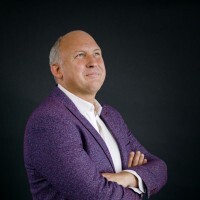
Jean-Sébastien Gosuin: Hello everybody! I’m a proud dad of two kids, Jack and Zoe. I’m from Belgium, so a very small country. As a Belgian, I have been educated in four languages, and, as a world citizen actually, my parents were living in South Africa for 4 years when I was a very young kid. I had different opportunities to travel and I studied economics at the University of Namur in Belgium. That’s who I am in a nutshell.
From filling Olympic seats to reimagining patient access
Miriam: Wonderful. So, luckily a well-travelled person. We’re very lucky to have you here today, because just to let everyone in on a wee secret. We are incredibly lucky that Jean-Sébastien is here because just before Easter he had a heart attack. Literally 10 minutes away from death’s door. But you’re here today, which is wonderful. Thank you for taking the call, even though I know you’re supposed to be taking it easy, and your consultant said you need 12 weeks, and yet here you are.
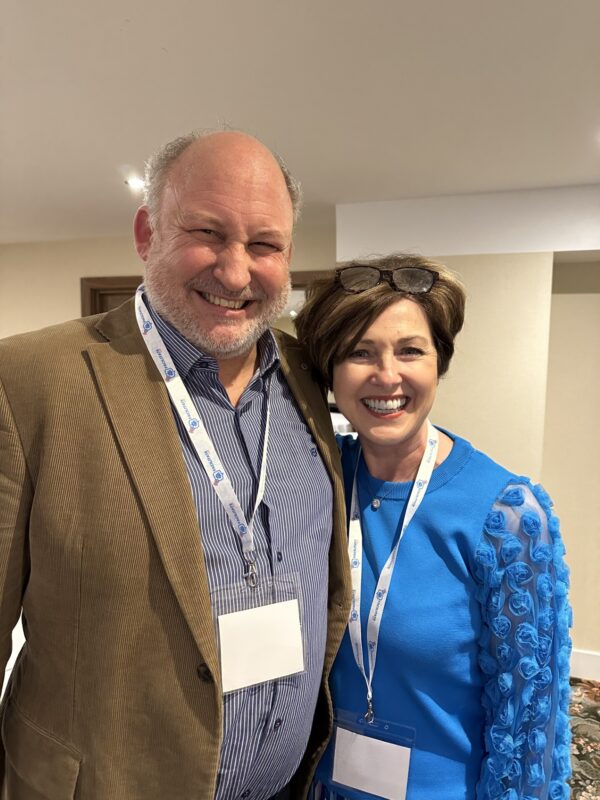
Jean-Sébastien Gosuin & Miriam Dervan
So, thank you, Jean-Sébastien. Just so that everybody is aware, I met Jean-Sébastien when I was at a conference with my other wonderful colleague, Louise, in London back in February. I was enthralled by your story and I’d really love everyone to hear your story, because you’re not from our industry.
So, if you go right back to the beginning, and tell us about how you formed Curewiki, how it came about, and why.
Jean-Sébastien: Actually it’s always quite funny in all these pharma events with these fancy research people, very clever people. I actually come from the sports marketing industry and more detailed, I was for 10 years ticketing agent for the Olympic Games with my first company I started 22 years ago, and doing some hospitality travel and VIP travel. I was blessed to win the contact for the Olympics in Belgium, not taking part in Belgium, but for the Belgian citizens willing to go to the Olympics. And then I had other contacts with Wimbledon, with Roland Garros in tennis, for the FIFA World Cup and so on.
It’s always very funny how we got to then becoming the founder of Curewiki, because it’s a story where everything is linked. Let me just give you a flavor of this. The first flavor is that I was always pushing my colleagues on “we cannot get late to the final of the 100 meters”. The time sensitivity is key, since whatever I have done in my life. Deliver on time because if we arrive late, the ticket is worth nothing anymore – it’s 9 seconds, the 100 meters final. And so, that was the first thing that I wanted to share. Time sensitivity is very important.
A very aha moment for me was during the London Olympics, where I was also in charge of Belgium. There was this scandal of the empty seats. I don’t know if it rings a bell for some of you, but the games were sold out, and still, in the front rows, there were a lot of empty seats in the camera vision. It was very bad for the Olympics and London, people were very angry because they paid Olympic tax for years, and they got no tickets for their own Olympics at home.
I analyzed the problem and the problem was actually corporate ticketing, where corporations, big sponsors, and so on got tickets, but the distribution was not well enough and not done.
That’s the second startup I created. I went to New York for that and I created SETERS with the idea to build software for the big corporations to better distribute their tickets. And again, time sensitivity, offer & demand and criteria to fill the VIP ticket with the right guest at the right moment. Everything went very well with that company, but at one moment, I was hit by a little worldwide event named COVID. Suddenly, no more seats to fill and my business literally collapsed. I was really at a moment of saying “stop or go” and thinking about bankruptcy.
Suddenly in 2021, at the start of the vaccination campaign there was a problem in Belgium on efficiency of no-shows and of people not coming up. I was thinking “Oh, actually if I can fill a VIP seat in a stadium maybe I can fill a slot for a vaccination campaign”. I went to the Ministry of Health in Belgium and we built QVAX, which was the official reserve list for nationwide to fill all the gaps in the Belgian vaccination campaign. That’s how I entered the health tech environment with a tech to fill the stadium to suddenly becoming a tech to fill the vaccination campaign.
Just to give you a number, there were 8 million Belgians to vaccinate and we got 2.2 million Belgians that registered saying “Hey, if there is a gap, a no-show, I am ready to fill that seat”. We were of course then respecting the exclusion criteria of respecting the age, the comorbidities, and so on. We vaccinated at the end 650,000 people, which made Belgium one of the first countries in Europe to reopen its economy because reaching the 80% vaccination rate. So that was really a first.
The second aha moment which is time sensitivity, but also I can now use a tech that is filling a stadium to fill a nationwide vaccination campaign. So what else can we do with this technology? And thinking about issues with offer and demand that are time-sensitive.
Very fast we discovered that there is an issue with how patients or participants are enrolled into clinical research, because we heard about that famous number of 80% tiles that are starting late or never because of a lack of patience. That’s how we started Curewiki, with this experience of filling stadiums, filling a vaccination campaign, and now helping to bring better results into the studies by having patient engagement.
Seeing clinical trials through a patient’s eyes
Miriam: That’s utterly stunning. Coming from the non-healthcare sector, from the sports sector and marketing, to what you’ve achieved now is just amazing. The entrepreneurial spirit in that is wonderful. I know a lot about Curewiki, I know our listeners probably don’t, so just tell us a little bit about Curewiki itself.
Jean-Sébastien: Before telling that, I must admit that we analyzed the market. Again, just like the empty seats in London, what is the problem? From day one, we created a team because it’s wider than my shoulders to solve this and even wider than Curewiki alone. What we discovered is that, actually the whole industry, and sorry for those in this room that are doing what I will say are study-centric. It’s normal because you are funded per study, you have your job per study, you have your green light from the European Medical Agency to start your study and to start to enroll, and so suddenly, you have a go and it’s a hunt for patients for my study.
As you said, I have cardiac issues and before that I’m a cancer child. I had cancer when I was 12 so I’m already, I dare to say, 3 times a survivor thanks to modern medicine, so I really believe in innovation in medicine. As a patient, let’s be honest, I don’t care that it’s a study of this big pharma, or this biotech, or this academic professor. I want a better life. I want to contribute to innovation. If I put myself into this environment where it’s all study-centric, I get bombarded by the ones that make the most noise. On opportunities that are pushed in my face whilst if I want to be a factor as a patient, where can I land? The result of our analysis was very poor.
Patient organizations try to do their best, but they are not equipped. My specialist, my cardiologist, he doesn’t know because he’s the frontline. He’s educated to do the standard of care whilst the site selection is based on “oh, these guys will bring us patients” and the front line is supposed to do some pre-screening. But again for my cardiologist, every 20 minutes a new patient has to do an effort test. How could he know all the trials that are in his own hospital? It’s just not working.
Same if I go on the internet, I discovered clinicaltrials.gov, clinicaltrials.-whatever, self-search tools. But with self-search tools, I can lie to myself. It makes false hope like “wow, 60 tiles for cardiac patients”. But when I opened the protocols, I was lost! I’m lost. I’m just a sports marketeer. Sorry, guys, I’m lost.
As a patient it was kind of “aha, what can I do?” The real solution we believe in or we want to bring to this market and it’s a market I dare sometimes to say is disrupted by startups and by tech. I have seen a lot of sites that are still working just like in the time of Marie Curie. With trial people that are going to the waiting room and literally speaking about their trial to people out of the blue, desperate to find patients.
Simplifying complex protocols for real people and real lives
Miriam: Absolutely, and for me, I’ve been in the clinical research industry for nearly 40 years, but we’re still talking about this. This is still an issue. The biggest issue in our industry is finding the patients, the enrollment and of course the retention – keeping them in. It’s such a shame that after all these years we’re still talking about them.
So to hear of your entrepreneurial spirit and coming up with just something that’s a little bit different is amazing. Curewiki is basically an AI platform that you’ve got all the studies in your platform and participants then, like I or you or anybody, could join Curewiki. How does that work? Tell us a little bit about it itself.
Jean-Sébastien: Exactly, so the idea is really to flip the paradigm. From a study-centric market to move to real because everybody wants to be patient-centric. Sorry again guys, but what we have seen and the best test ever when you look at the websites of patient engagement tools and so on – their homepage. Look to the homepage of any patient engagement or patient enrollment vendor. If on their homepage they talk to you “we find your patients for your study”… Sorry guys, you are study-centric.
But if you talk to the patient, “hey, have you thought about the clinical trial option to maybe contribute to innovation and maybe find a better solution for yourself?”. You talk to the people and that’s really what we bring.
We flip the padding, we start from the patient. And there the first problem we saw is “oh, all these protocols, they are absolutely not standardized, not structured. Everyone says it in free text. So how can we handle the criteria?”
Sometimes as an entrepreneur, you need a little bit of luck. In 2022, OpenAI came up with ChatGPT and all this AI stuff and so from more a data approach of reading all the protocols with LLM and so on. We really moved directly into the AI usage of the AI tech, to read all the protocols, to concatenate all the in and exclusion criteria for all the trials.
Let’s take my example. There are 100 trials in Belgium looking for cardiac patients. All of these tiles ask an age limit – above, below or between. All these trials have a body mass index. Sorry, I’m a sports marketeer, I don’t know the formula, so what’s my weight, what’s my height?
By concatenating all these criteria and only asking once to the person their weight and height just one time, we recalculate the body mass index and we can, per study, say “oh, he’s in or he’s out” depending on what we have recognized as a criteria. So it’s a questionnaire dynamically generated based on all the in-end exclusion criteria of all the studies out there. As a patient, I have the question only once. And the next question I get is the next question that can exclude me from as many trials as possible from the list of trials that are still possible.
So from 100 trials in cardiology for Belgium, my age, minus 20. My body mass index, minus 17. Then the next question will be the question that is appearing in the next needs for the next trials in as many trials as possible, so that my next answer can again exclude me from as many trials as possible. Because we want to avoid false hope.
As a result, as a patient I get a shortlist with the trials where I am a positive test screen based on my answers. Then I can discuss that shortlist with my cardiologist and I can choose the site where I can join that trial. So it’s really bringing it from the patient and starting from the willingness to participate of people. People want to help. They just don’t know where to start.
Making it easier for patients to find and take part in clinical trials
Miriam: They genuinely do and so many people don’t even know that it exists or that clinical trials exist. Or participants who aren’t sick don’t even understand that they can also participate in trials. You don’t necessarily have to be sick.
Tell us then how do you find the communities? Where are you going to find participants? Because, for example, I’m from the West of Ireland my dad unfortunately passed away with bowel cancer many years ago but if I had known… If somebody else had known that their dad could have been in a clinical trial to help them but we don’t hear about these things in the communities. How do you find all these participants?
Jean-Sébastien: Very good question. We started with social media, Google AdWords, and by the way, a huge difference with most of the patient hunters, or bounty hunters, if I dare. Our ads are not refused because we don’t talk about your trial for your study. We talk about, “hey, if you have cardiologic issues, have you thought about a clinical trial option?” We are very neutral and people register and join the movement. So that was the first, and then, by thinking a little bit wider, it was kind of do we really want to make Facebook and Google rich, or do we try to find another solution?
So since last year, we moved into partnerships with patient organizations and with hospitals, where we offer our technology to be embedded. We can offer the Curewiki questionnaire to be embedded in the communication tools that these stakeholders have. Because the question was “where are the patients?”. The patients are in their communities, with the patient organizations, with the hospitals. So we integrate our tech into the partners that we have. We see that the patients come from the patient organizations and so on that joined the movement.
We started in Belgium. Ireland is still not very well deserved, but we are from startup to scale-up now, so we now go to a scale where we aim to partner with as many hospitals and patient orgs in the Big Five, as they name it, so France, Germany, Spain, Italy, and the UK.
Since day one, all the trials that are live now recruiting in Europe are live on Curewiki. That’s one of my big lessons of the vaccination campaign and the Ministry of Health was saying initially “Oh, there are 110 vaccination centers in Belgium, but only 17 have asked for a reserve list, so we opened only 17”. There my answer was “over my dead body”. How could you say to someone from Liege “oh, no, you cannot register as a reservist whilst we do those from Leuven”? So it was about letting people ask. Any person in Ireland, in the Czech Republic, wherever in Europe, can register and can find any trial option that is now existing and will have the questions to find these options.
Very importantly of course, as a startup and scale-up, we have limited resources, so we move where we are the most effective. That’s why the Big Five is our priority now. I’m super happy and proud, literally today, this morning, we signed with POP. POP is the grouping organization of all patient organizations in Spain. So we just now have a Big Five in Spain, where we will be introduced by this patient movement in Spain, in order to have them join the movement.
What’s holding patients back from participation
Miriam: Well many congratulations on that Jean-Sébastien. I know that you and I have talked a good bit as well about hopefully you moving into the US arena.
We’re kind of running out of time here, Jean-Sébastien. I mean, I could talk to you all day, but I really wanted to ask you a very important question, because you had mentioned this, and this is what really caught my attention when we met back in February.
You had mentioned about the top reason why participants don’t participate in trials, and I’d really like you to kind of talk a little bit around that. And also, we know the top reason, but do you know the other kind of maybe top five reasons? What are those reasons?
Because this would fall very nicely into us wanting to support participants. We want participants to stay in. We’re in front of patients every day. We hear from them and we hear from their families, we hear their cries, their pleas. We want to try and have more exposure so that patients understand that they can have support.
So, please tell us a little about the barriers that you’ve come up with.
Jean-Sébastien: This question is a key question and let me build up on that. We have today passed the 40,000 almost 50,000 users, after just one year of operations. They have answered 2.5 million questions to date or they got 2.5 million questions, because the questionnaire is approximately 60 questions, because the last question is the last tile to pre-screen you for every single trial option. Guess how many percent of answers we got? Out of 2.5 million questions we got 92% answer rate. We expected 60% but it’s a huge proof point of the willingness to participate.
People look for solutions and so we got 2.5 million answers to the questions we asked. With all these answers, we have decided to build an insights tool that we offer to our customers. In these insights, we discovered that out of the patients that got options to participate, when they have the shortlist of options, they can either ask to participate and choose the site where they want to go, or they can reject the tile to clean their shortlist, or they can just don’t do anything.
Out of 100,000 trial options, participation options that we suggested to our registered users, approximately 20%, so 24,000, pushed the reject button. And out of that, 50% we asked then, “Why do you reject?”. 50% was because it’s too far away from me.
And very interesting, when we went deeper into the answers of all these people, we saw, because one of the questions is “How many kilometers are you ready to drive to participate?”, there we discovered a sub result that is even more dramatic. I would dare to say, towards diversity, towards service and towards society. It’s that men are ready to drive up to 100 kilometers, and it’s the answer from 50,000 people. How many kilometers are women ready to drive? The answer is 50 kilometers on average. So, women are ready to drive two times fewer kilometers than men. Why? Because there is school and kids to handle and so on. It’s dramatic because it means that from a participation point of view, the most rejections were from women, because the trial was too far away.
And that’s where our encounter with mdgroup is a fantastic moment, because now, we are introducing the question “Would you be ready to be driven to the trial or drive yourself or have a hotel service or whatever”. So, it’s to see how we can help these people because it’s too far away or can we bring the trial to you?
Miriam: This is kind of what blew me away, Jean-Sébastien, when we met. These are the statistics that we need to hear about and the reasons why, so that many other people can participate. There shouldn’t be these barriers anymore.
Jean-Sébastien: Absolutely, and the gender inequality, we see it a lot and we have done some more specific numbers on that. For instance, and a lot of women are excluded from trials because they want to be pregnant, because they are breastfeeding and so on. So there is a real challenge there for gender equality and we can now show hard numbers. I think a nation of almost 50,000 people it’s more than any Ipsos study or whatever of the people.
Continuing to fill the seats in clinical trials
Miriam: Absolutely, voice of the people. It’s very interesting to even hear you say that, because I was in Orlando at a conference at the weekend, and I spoke to a lovely lady who works in Obs and Gaini, and she was saying exactly that and she said all our ladies who are in Obs and Gaini and lots more aren’t getting the opportunities and there’s nothing there for them. It’s terrible, they shouldn’t be excluded.
Jean-Sébastien, unfortunately, it is time off.
Jean-Sébastien: We could continue talking and sitting in the sofa together for ages.
Miriam: We could! I’m just going to end on something that our gorgeous Perla Nunes said. I had the pleasure of meeting Perla in San Diego and I met Perla again in Orlando. Perla Nunes wrote in her quote saying “We need more Jean-Sébastiens in this world”. So, well done Perla for coming up with that. Never a truer word. We surely do.
Jean-Sébastien, thank you so much from myself, from all at mdgroup. You know, wonderful to hear your story again. You are enlightening and enthralling. Please keep up the great work, it’s amazing.
Jean-Sébastien: Absolutely, we will do.
Miriam: Thank you so much, and thank you to everybody for listening in. Keep safe, and no more heart attacks.
Jean-Sébastien: Sure, thank you. And remember, this is a picture from Artemis, three weeks ago. There are no borders, no skin color when you see the Earth from the moon. We are all equal, and just do our best.
Miriam: Right. A thousand percent. Okay, Jean-Sébastien, see you in London. Thank you, thank you. Bye-bye.
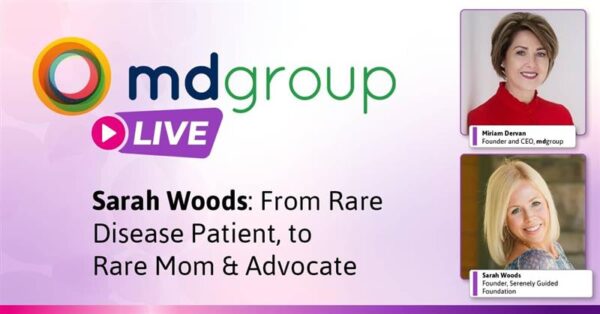 Have you already seen the previous mdgroup live episode?
In this powerful conversation, Miriam speaks with Sarah Woods about her journey from rare disease patient to rare mom and passionate advocate. Sarah shares how her personal experiences navigating diagnosis, care and uncertainty have shaped her mission to support other families facing similar challenges.
Her story sheds light on the realities of living with a rare condition, not just as a patient, but as a parent, and highlights the importance of advocacy and a more compassionate, patient-first approach in clinical research.
Watch the full episode or read Sarah’s story here.