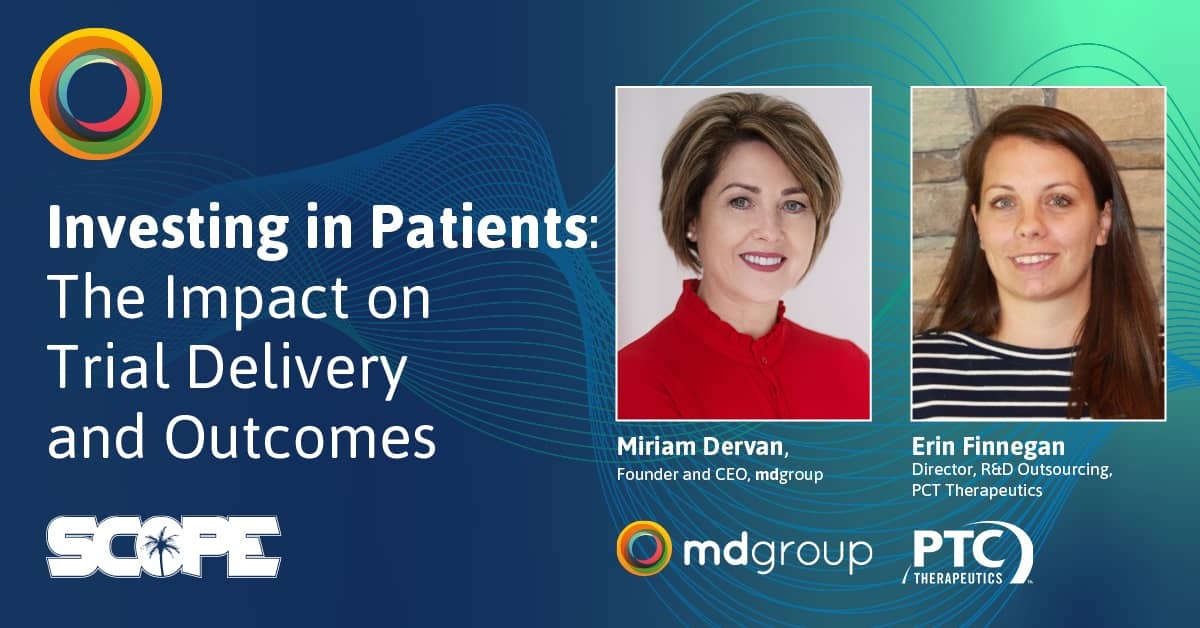
mdgroup had the opportunity to host a breakout session at SCOPE Summit 2026 in collaboration with PTC Therapeutics, a global biopharmaceutical company, focused on the topic of what happens when you deliberately invest in patients during trial design.
PTC Therapeutics is committed to providing access to best-in-class treatments for patients with little to no treatment options. This mission underpins their focus on the discovery, development, and global commercialization of clinically differentiated medicines for those with rare diseases. As a patient-centric, global pharmaceutical company, they combine clinical and scientific expertise with groundbreaking science and technology, always with the patient in mind.
Titled “Investing in Patients – The Impact on Trial Delivery and Outcomes,” the session featured Miriam Dervan, Founder & CEO of mdgroup, alongside Erin Finnegan, R&D Outsourcing Director at PTC Therapeutics. Together, they explored real-world experience from complex studies, examining how embedding patient support services early influenced study confidence, retention and operational delivery.
PTC Therapeutics recognized that traditional trial models would not fully address the lived realities of participants and caregivers. Working alongside mdgroup, the team integrated enabling services such as in-home support and logistical coordination directly into the study framework.
Below, we share the full session conversation:
What prompted PTC to invest so deliberately in patients for the ALS Huntington studies?
Erin Finnegan: Yes, so PTC recently has run a few studies within Huntington’s disease and ALS, which are both incredibly challenging neurodegenerative diseases that affect adults, its later onset in life, and we’ve been integrated within the patient communities for so long and working with our patient engagement group, directly with the advocacy groups, but then also directly with the patients and the patient’s families that we recognized at the beginning of the trials that we really needed to bring something special for these patients.
They are really suffering from these diseases. It’s not easy to go through life with them and especially as we asked them to give so much for our trials and to participate with PTC in these trials. We really wanted to bring that elevated service to make them feel like they were part of the family at PTC and not just, “Hey, come give us your blood and then go home”, right? We wanted to make them feel like they were actually people and not just data.
Did you decide to prioritize the patient experience because the studies were more complex?
Erin: I think, honestly, it’s the diseases that are more complex. That’s when we have to prioritize the patients and what they’re going to be doing. We have to really sit down with the patients ahead of time and ask them, “Tell me about your day-to-day life. Walk me through a day in the life of having this disease.”
We need to think of how we, as PTC, can bring on strong partners that are also dedicated to making sure that we’re not making it harder by asking them to participate in our trials. Making sure that they feel supported and they feel like they’re not a burden if they ask for something or if they need something, especially in the ALFs and the AHD communities.
They deal with so much that we don’t even understand and I can’t realize what they do and just how they even have to navigate the world and have them navigate if they have to go through a train station. Is there handicapped parking or where is it? How far is it from the terminal point? Is there elevators?
I don’t have to think about that and it’s humbling in a way that I’m happy that I have that simple of a life but we have to really expand ourselves. We have to learn what our patients are going through and how can we help them and best support them.
Miriam: I know, because nobody understands really what’s going on with the patient or with their families. A lot of patients that we deal with are also children in pediatrics and they are so frightened, so scared and their families are so frightened and so scared for them, that we just need to care for them, absolutely so totally understand that.
Was there a moment or a challenge where it became clear that the traditional trial models weren’t enough for your patient population?
Erin: It was a complex study. Yes, we’ve had some and the ALS that you helped us with was incredibly complex and as we were working through the design of the trial, I’m really beginning to say, wow, this is a long trial. There are a lot of visits.
What can we do? How can we leverage a vendor like mdgroup so we can do in-home care? How can we make that as easy as possible for our subjects and our patients want to stay on the trial and that’s a big piece is that retention piece.
When you lose a patient from a trial, it’s heartbreaking and expensive, unfortunately. So we really want to have the patients who are engaging in the trial remain engaged and want to continue and come back, especially on a long trial like ours.
Miriam: That’s the real challenge really, isn’t it? Just enrolling the patient is hard enough and then when you finally get the patient in, keeping them in the trial is so difficult. So offering these kinds of services truly helps with retention because our services, they really are critical and essential, enabling services to help with all sorts of trials but particularly, the PEDS trial that you guys are doing.
When the patient experience initiatives are being evaluated alongside other tribe investments at PTC, what helps them stand out as essential rather than optional?
Miriam: This is the thing, this is where a lot of clients and sponsors don’t think about the essential enabling services that we have. The patient is usually near the bottom of the list, even though the patient has to come first.
Erin: Yeah, I think we’ve worked closely with mdgroup at the beginning of the trial. Since we’re doing the trial design and starting to write the protocol and saying where do you see the hurdles and where can we help mitigate that and so that’s what we’re going to change operations at the beginning to make sure that we are setting ourselves up for success by engaging in the services that we need with mdgroup.
But in terms of where does it become optional to really require, it’s putting yourself in the seat of the patient. If I sit there and I say, “Is this something I would want to do?” because I’m sure most people, I get emails from my kids’ doctors saying, “Hey, do you want to be a part of this clinical trial?” My mind goes “Maybe I do, maybe I don’t, maybe I want to engage with that”, but with someone with a rare disease, there’s a lot more at stake when you’re weighing whether or not you’re going to engage with a clinical trial or not.
Having those services in place up front, I think, is very important and communicating that to the patients as well in the beginning. PTC comes at it patient first.
We talk about it a lot, half of the speeches I’ve seen already today being patient-centric is a buzzword that’s thrown around. It’s just very important that we remember they’re humans and they are in these trials and that’s really the most important thing.
So from a PTC perspective, we are patient first, we really are. I can even tell a little story that even in my first interview with PTC, that’s what they spoke about. They spoke about patients first and they spoke about how we bring patients in and we do a lunch and learn type session. So we really do drive it home day one of the interview.
Miriam: That’s great, that’s so meaningful. As a company, with mdgroup, we’ve worked with PTC for a number of years and that is so true. They genuinely put the patient first and it makes such a huge difference and is really just for your study and for your patients.
What did you see as the main advantage from a project management perspective of working with a company like mdgroup to prioritize and support your study?
Erin: From a project management perspective, I know our clinical operations folks love working with mdgroup because it’s so easy.
There’s a big burden that’s taken off of our teams for having to manage things and think about things, but really able to turn over and put it in another company’s hands and we know that we’re being fully supported.
So from a project management perspective, it’s really the day-to-day operations that are lifted from PTC so that they can focus on the other pieces of the operational side of the trial instead of “Oh wait, I’ve got to approve this train ticket, these train tickets”. So it’s very helpful.
How did that patient-first approach change the experience of participants and caregivers compared to other studies that you’ve run in the same area? What difference did you see since the previous trials?
Erin: I think it starts day one when they come into the clinic for the first time. They’re presented with packets of information saying, “These are the services that are available to you. This is how we’re going to make your life slightly easier as you navigate this trial”. And then throughout, we’ve heard stories from your folks of just “Hey, we’ve gotten to know the patients, we know who they are, we know their family members, we know their cats’ names”.
Miriam: That’s right.
Erin: They’ve developed a relationship that we’re unfortunately unable to develop because we have to keep them all the time, the patients and us. So we’re able to rely on mdgroup to build that relationship and speak for us. And really be that conduit of relationship for us.
Miriam: That’s so important. We hear so many stories from our own team that they get to know the caregivers, the families, and the patients themselves. And even when the study finishes, we get patients and families contacting us if something is not right with their daughter, their son, and yet we’re helping them and still helping them.
It just shows you the insecurity that they feel when the study and the trial are finished and how we get to know them. It’s amazing. Honestly, you have to bring that human touch to these people because they are the patients with the illness and the disease and they are right.
Erin: Right, right. You have to find the human touch. That is all the difference. We’ll never go away. We cannot AI away human touch and having those relationships and that communication.
And we’ve actually received feedback on trials once, coming in with mdgroup and using your services, that “We loved it, we were able to just make a phone call and anything solved for us”.
We had an issue with a delay. We had to make changes. And we were able to just call up and almost like a concierge service if things changed, whereas previous trials, I think, got no feedback, which was bad. We didn’t hear anything, right? So there were unnecessary complaints, but there weren’t the accolades. So we get the accolades, which is huge.
Within these small patient communities, you’ve got, especially now with the onset of social media. You’ve got patients advocating for PTC. You’ve got patients advocating for mdgroup for other trials and saying, “Hey, I’ve worked with this, with PTC. I’ve worked with mdgroup and they did an excellent job”. And then they’re posted on social media and then it spreads, which is not something that would have happened 20, 30 years ago. Word of mouth wasn’t as widespread.
Miriam: And now with social media as well, it really helps geographically. It really helps as well to get out there and look for patients in regions that you never thought of before.
What are the most tangible impacts on recruitment, retention, protocol adherence, and the overall study confidence?
Erin: I think starting with that study confidence really trickles down into those other pieces. And I’ll say, study confidence is not the same thing as drug confidence, right? You can have faith that the drug is going to work. It may or may not. But study confidence is coming in and saying, I know I’m going to be able to show up every single time I’m asked. I know when I do show up, there’s going to be someone there who’s able to help me more. I know that the trial will come to me with the annual health care.
I can’t leave. I can’t get out and leave the multiple health options. So instead of bringing the patients to the trial, I bring the trial to the patients, and they feel supported.
And then that confidence is going to trickle down into the retention piece. Yes, they’re going to want to stay on the trial. They’re going to want to make confidence that the data is going somewhere good as well. I think that study confidence, if we look like a really well-oiled machine, there’s confidence that the trial is going to be well-oiled as well.
Miriam: Absolutely. We have aligned ourselves with a lovely lady called Kevin Franchetta. Franchetta, I don’t know if you’ve met her from the patient’s view.
What they do is they take your protocol and they look at the patients outside of different communities to see how they fit into that protocol. They will work out what the patient is looking for, and I just think that’s an exceptional thing to do.
I know that a lot of companies nowadays you can see they’re very focused on the patient engagement, patient retention piece. But they have to put their mouth to their word and really invest in the patient.
We got to know a patient recently called Sarah Woods. She actually has a rare disease, and her son also has the same genetic rare disease. She has set up a foundation called Serenity Guided Foundation, where she wants to put together materials that you can hand to the patient to say, “Look, these are all the services that you can get”, because she never knew about services like what mdgroup had. And she had to come out of the trial because she is a single mom and has a seven-year-old son, and she works from Monday to Friday. So when they’re going to visit on a Wednesday at lunchtime, she can’t do that. So she had to come out of the trial. She set up that foundation, which I thought was brilliant of her to do, because they want to stay in the trial.
And this is it. It’s really important.
Erin: I think at PTC, we have a whole team for patient engagement that does something very similar. They do that outreach to the patient communities and to the advocacy groups, and they know the families, and they get to know the families. They understand really what the challenges are that they face, what the challenges are that the caregivers face, what the challenges of pediatric study are. They want both of the parents to attend, or there’s also an elderly grandparent at home. There are just all sorts of challenges that really exceed just the disease.
Miriam: Nobody realizes that because when you look at operationally how things need to change when you take on board the patient and what they’re looking for to help them.
You’ve got to look at things like even at the site. The site could be a big hospital. You might have an Alzheimer’s patient who’s got to be there for four or five hours. One side of the hospital is the X-ray, and the other side of the hospital is something else. They’re there for four or five hours. You’re trying to bring them to these different treatments. And it’s really difficult. No one thinks of that.
This is where we have to put the patient first. It is so important. Looking at you guys at PTC and how you did that, I mean, it’s amazing – the outcome of your trial and the impact of your trial.
What was the outcome of your trial and the impact it had when you look at your results in terms of cost and retention?
Erin: Yeah, in terms of the cost and the retention fees, it’s hard to put a dollar value on it, because if we’re able to retain all the patients, and that’s wonderful. It’s hard when you have the loss of patients and it’s like “Oh well, I didn’t have those services, and now I have these patients”. That piece, I think, is a little bit difficult to enumerate, especially to the finance teams and say “We need this service, because if we don’t, then we might lose subjects, and at that point, we will lose money”. So the return on investment isn’t necessarily understood in the moment.
I think there’s also a lot of soft pieces to that retention. When the patients and the patients’ families work with mdgroup and PTC, they’re more likely in the future, within those advocacy groups and those patient communities, to say, “I’ve worked with PTC before, and they’re excellent. I’ve worked with mdgroup and they’re excellent. If you have the opportunity to go on a trial with them, you really should, you’re going to feel supported through the whole thing”.
I think that’s where we see the biggest impact on the trials, and then really the feedback that we get from those patients of “it was a pleasure to be on this trial”. That’s always very exciting feedback to get.
If you had one piece of advice to give to sponsors in designing your trials for rare disease or whatever, what would it be?
Erin: Well, I think getting to know the patient community is very important. I’ve spoken a lot today about the impact of rare disease, but it’s true even in non-rare disease that you can get to know the patients. You can just get to know the people who might be interested in going to your trial to get their perspective on how things can be made easier.
I think also from my time at PTC, what I’ve really tried to do is take the outsourcing role from tactical to being partnerships.
So I’d say we have one of the strongest partnerships, really. It’s such a pleasure.
Miriam: Values.
Erin: Yes, our values are very aligned with being patient and centric. Finding those vendors that you align with on a value perspective and then cultivating the relationship. Because you never want to go to work and be like “oh, I’m going have to call this person, ugh”. That’s terrible. It’s not how you want to be at work as well.
I think that there’s immense value in building a relationship with those vendors that you know, that you can rely on and that share the same values as you do.
Care first, science follows – a message from Miriam Dervan
Miriam: I’ve been in the industry for almost 40 years. And years ago, we used to call the patients subjects. I know there are numbers for a reason but behind the numbers and behind the subjects are the participants who are very scared and frightened people, very scared and frightened patients.
Patients who would trust us with their courage, we owe it to them to give them our compassion and our empathy and most of all our respect. Because clinical trials are not just data points, they are stories, they’re lives, they are hopes and cures. If we forget about the patient, we forget why we are here. You care for the patient and I promise you the science will follow.
We have to care for the patient and the science will follow if you put your patient first. It’s really important because these are people who hold the data that you all need and yet most of the time they are left at the end. You have enabling essential critical services that truly help and support the patient. Please be cognizant of that.
The breakout session made it clear that patient-centricity is not just a buzzword, but a practical, operational choice. By investing in patients early, PTC Therapeutics and mdgroup showed how study confidence, retention and overall trial performance can be significantly strengthened, especially in complex rare disease studies.
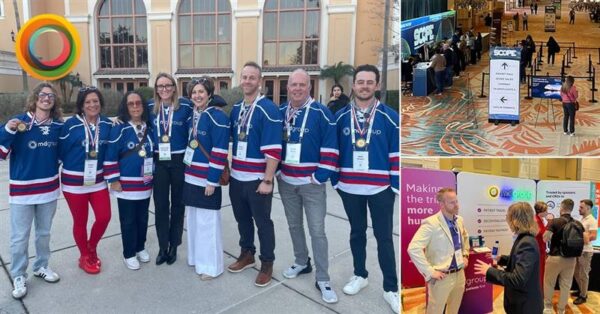 For PTC, embedding patient support services was essential. For mdgroup, partnering to provide those services highlighted the real impact that thoughtful, compassionate operational support can have on participants, caregivers, and study teams alike.
This session was just one part of the larger conversation at SCOPE 2026 about improving clinical operations, patient engagement, and trial design. To explore additional insights from the summit, check out our full SCOPE 2026 recap here.