At mdgroup, clinical research is more than a profession — it’s personal. Why We Care is a series of real-life stories from our team, sharing how clinical trials have touched their own lives, families, and communities. These experiences drive our passion for delivering remarkable patient-centric solutions and reinforce why we’re dedicated to making clinical trials more accessible, compassionate, and human.
Every story is a reminder that behind every data point is a person, and behind every treatment breakthrough is hope.
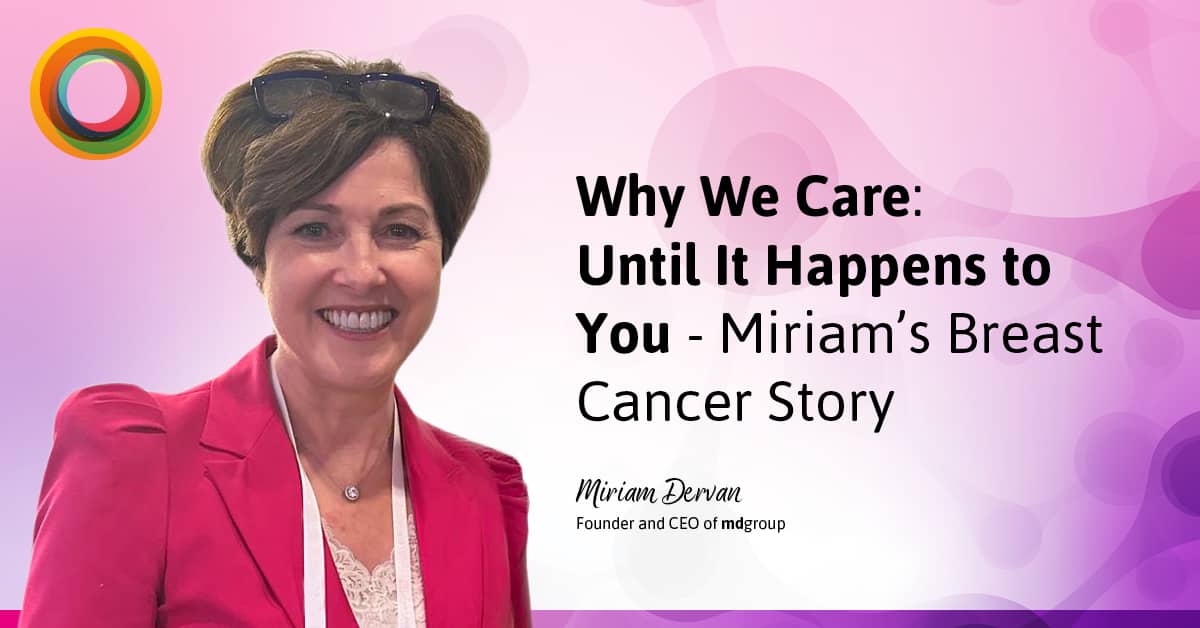
For Miriam Dervan, Founder & CEO at mdgroup, cancer has touched her family in many ways, but she never expected it to become part of her own story. Her personal experience changed the way she thinks about health, early detection and the importance of looking after yourself. It also gave her an even deeper appreciation for the work being done across clinical research and the people at the heart of it. This is Miriam’s story and why she cares.
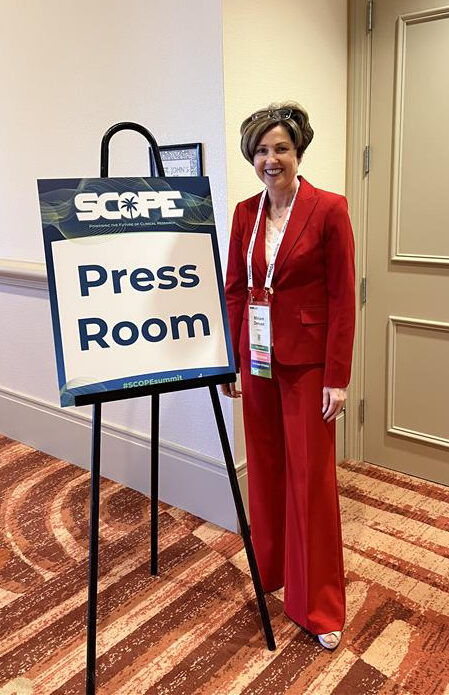
“There is cancer in my family, on both sides – my mom’s side and my dad’s side. So I’ve always been very aware that it’s probably going to be in my genes.
My own first experience of it was back in 2019. Sometimes you’d feel bloated, you might have a bloated tummy going to bed. And when you wake up the next morning, normally your tummy should go down after you’ve been fasting overnight. But I noticed over a week, my tummy wasn’t going down and I knew there was something wrong.
I got a CT scan done to discover I had a lump on my right ovary. Fortunately, it turned out to be benign, but I still had to have keyhole surgery in hospital to remove it. It was quite scary.
You always think something like this is going to happen to somebody else, but that is not the case. It can happen to anyone and it happened to me.
Because of that experience, I was quite aware with getting older, I needed to look after myself. I was 51 when I found the tumor on my ovary and I just needed to make sure everything else was ok. I had planned on doing a full general health MOT in 2020, but COVID hit and that was that.
In 2021, everything was still going on with COVID, hospitals were closed to outpatients. Towards the end of 2021, we were all coming out of COVID and they were not as strict on restrictions anymore. I decided it was time to get a full MOT done. That was in November 2021. However, prior to that in September 2021, I had been to see my gynecologist. I had to continue checking the other ovary. I asked the gynae to examine my breasts, and when she did, she said everything was fine.
After that, in November, I got the whole MOT done and included a mammogram. In early December, the consultant from the clinic called and said ‘We’ve seen something in your right breast and we’re concerned about it’. At first I was disbelieving her because I had only been checked by the gynecologist a few weeks before. She had given me the all-clear. However, the consultant was insistent and said, ‘No, this is something that’s right at the back of your right breast’. I brushed it off thinking it wasn’t anything urgent. The consultant, on the other hand, knew it was more serious, however, as we were so near Christmas, she said ‘stay at home in Ireland, but the very moment you come back to the UK, I want you to see your breast surgeon’.
I returned to the UK very early in January, and had made an appointment in the meantime. I went to the breast surgeon and spent an entire day at the hospital doing various tests and scans. As it turned out, I actually had breast cancer and it was aggressive. Fortunately, it was caught very early. The consultant and surgeon said at the time ‘Miriam, if you hadn’t caught it at this stage, it would have been a very different story for you in four to six months’.
At that point, the tumor was 11 millimeters and I was booked in two weeks later to have the surgery. Back in 2019, my ovary surgery was keyhole, but this surgery meant they were actually opening me up and removing it – a lumpectomy but not a full mastectomy.
The day before my surgery, I got all the tests and scans done again. The surgeon confirmed that in a matter of two weeks, the tumor had doubled in size – it had grown from 11 millimeters to 22 millimeters. That shocked me. At that moment, I knew this was more serious than I was truly believing.
The surgery day arrived and hospitals were not allowing family to accompany patients. It’s January 2022. I’ll never forget being in the hospital on my own. I sat there on the bed at 8 o’clock in the morning, in the gown, waiting to go to the operating theatre. The surgeon came in and said these very words: ‘Look Miriam, I just need to say this to you. We have done all the scans and all the X-rays and all the MRI’s, everything that goes with it. I cannot guarantee that it has not spread into your lymph nodes and I won’t know until I go in’.
And then she left. I’m there by myself, thinking, ‘What am I going to wake up to?’. That’s when the fear set in, I’m thinking, ‘What if it has spread into my lymph nodes ‘. I was truly scared.
After the surgery, in the recovery room, I’m waking up in the daze and immediately thinking ‘What’s happened? What’s the news?’. I saw my surgeon walking over to me and such a relief to hear those reassuring words: ‘We got it all out, Miriam, and it has not spread into your lymph nodes, we got everything out’. She continued, ‘I even took out more than I should have had but the lumpectomy went very well’.
Since we got it all out and everything was fine, I didn’t have to do chemotherapy which I was relieved about but I had to do a course of radiotherapy afterwards which wasn’t too bad.
Since then I’ve been looking after myself. I’ve been very aware that I am susceptible to cancer and it can come back at anytime. I have been looking after myself year on year, which is so important.
My message to everyone is – please just get checked!
I wouldn’t have known about the breast cancer only for I pushed myself to get a general MOT done.
It’s so important, no matter what age but particularly as we get older, do not be afraid to get checked. Do not be afraid to go to your doctor. Do not be afraid to get a whole MOT health check done because those things can really save your life.
Until you’re going through it yourself or somebody incredibly close to you is, it is so difficult to truly understand what it feels like. That’s why the work we do here at mdgroup and in our industry is so important. Looking after our patients, finding cures and simply caring for each other, can be life-changing. The work we do is remarkable and everybody are heroes in our industry, there’s no doubt about it.
When I look back, I lost a first cousin to bowel cancer, he was only 36. I lost my dad to bowel cancer, he was 77, which was still very young. I lost my aunt to cervical cancer and I’ve lost other aunts and uncles to various cancers.
I am counting my blessings and incredibly grateful. I don’t know what it was or what drew me to getting that whole MOT done and mammogram that literally saved my life.
I would urge everyone and anyone to look after yourselves. Early intervention is huge. It’s up to ourselves to get those checks. Don’t take your body or yourself for granted. Please take care of it and look after it. Especially when you go above 50, things are a little more precarious. We all need to be very kind to ourselves and very kind to each other and be very kind to our bodies.
It’s great to talk about my cancer journey but still the biggest thing that baffled me was that even though I know there is cancer in my family, you still never believe it’s going to happen to you. It’s ‘Me? Really? Do I have cancer? Really, it’s me who has breast cancer?’. You always think it’s going to happen to somebody else, not you.
Care for you.”